
What is shingles (herpes zoster)?
Shingles is a viral infection caused by reanimation (reactivation) of chickenpox virus (varicella-zoster virus) which has been in a state of suspended animation in a patient’s body after encountering the chickenpox virus. The duration of the latent state varies among individuals who had chickenpox earlier from as early as ten years of age and younger to as late as in their fifties and above.
It typically forms vesicles on a body part in which a neuron runs, usually on either right or left side of the body in a band-like distribution with accompanying pain (figure 1).
It typically forms vesicles on a body part in which a neuron runs, usually on either right or left side of the body in a band-like distribution with accompanying pain (figure 1).
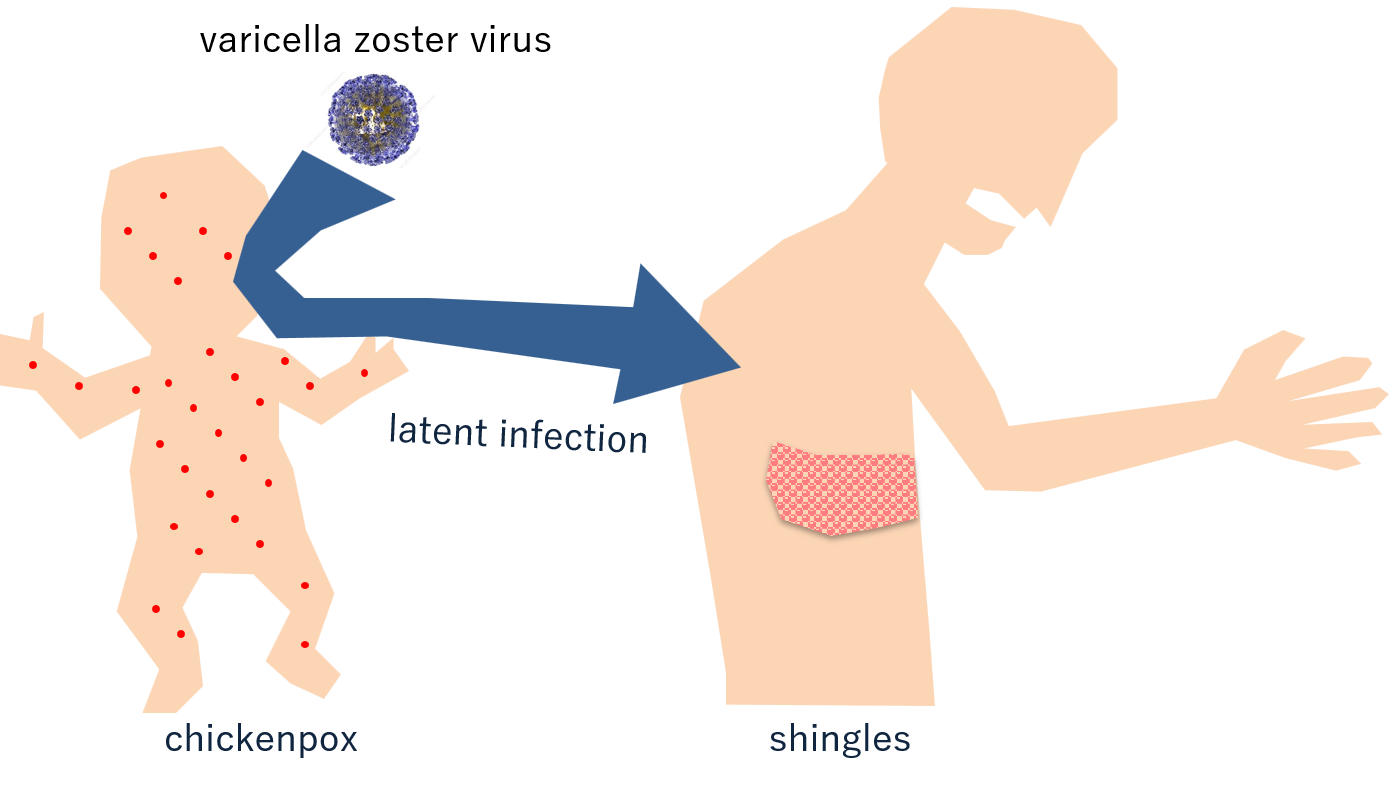
Figure 1. Both chickenpox and shingles are caused by varicella-zoster virus. The virus lays dormant in the nerve root of tactile sensation after the development of chickenpox usually in childhood and it becomes reactivated and develops into shingles as it moves down along the spinal nerves later in life when the individual’s immune system against the varicella-zoster virus weakens.
Symptoms and complications of shingles
Unlike many other viruses, as mentioned previously, varicella-zoster virus is not eliminated from the body and it stays in the nerve root of tactile sensation after one having chickenpox. Shingles develops where spinal nerves are distributed on the skin when one’s immunity against the virus is lowered. The spinal nerves run to both right and left directions symmetrically from the spinal cord in the back bone, shingles forms eruptions in the specific body segment where a spinal nerve runs in the skin. The eruption of the affected area starts with redness, then vesicles, finally forming a scab and sheds in the end. It takes about three weeks to reach a complete disappearance of these eruptions.
Complications can be experienced depending on which spinal nerve is involved. For example, if shingles appear in an area involving an eye, it can trigger an ocular inflammation or corneal ulcers, so a dermatologist needs to corroborate with an ophthalmologist to assess and treat the condition. Likewise, if shingles involve an ear, it can also develop facial palsy and/or hearing difficulty, which necessitates a consultation with an ENT doctor.
Also, the pain caused by spinal nerve damage occurs in over fifty percent of our patients. Although the pain may disappear as the eruption of shingles goes away, it can chronically linger for months to years even after disappearance of the eruption. This chronic pain is called post-herpetic neuralgia, which a dermatologist may manage with an anesthesiologist.
Complications can be experienced depending on which spinal nerve is involved. For example, if shingles appear in an area involving an eye, it can trigger an ocular inflammation or corneal ulcers, so a dermatologist needs to corroborate with an ophthalmologist to assess and treat the condition. Likewise, if shingles involve an ear, it can also develop facial palsy and/or hearing difficulty, which necessitates a consultation with an ENT doctor.
Also, the pain caused by spinal nerve damage occurs in over fifty percent of our patients. Although the pain may disappear as the eruption of shingles goes away, it can chronically linger for months to years even after disappearance of the eruption. This chronic pain is called post-herpetic neuralgia, which a dermatologist may manage with an anesthesiologist.
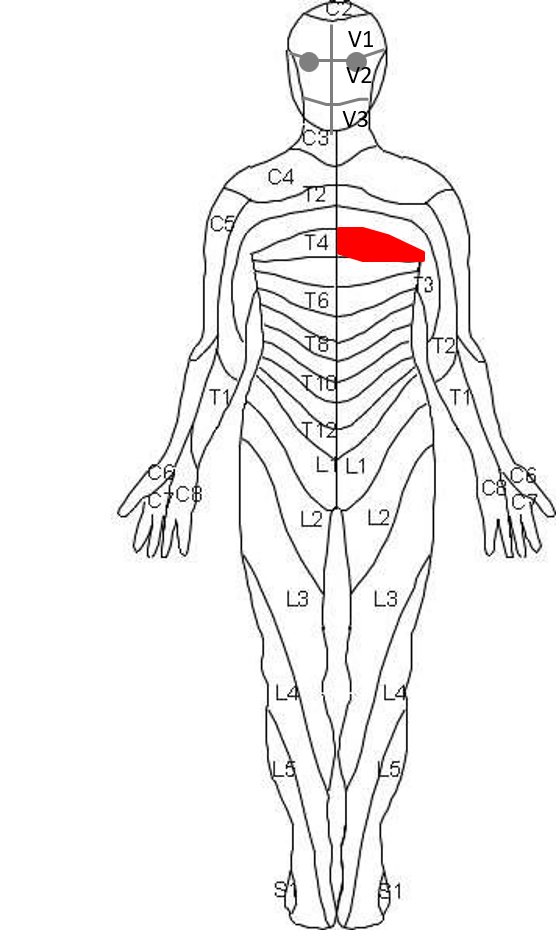
Figure 2. This shows the distribution of spinal nerves on the skin. Red area is an example of a segment in which a chest spinal nerve runs. This segment goes around the torso to the back side at the same level.
The diagnosis and treatment of shingles
The diagnosis of shingles can be made by dermatologists simply upon seeing the lesion after careful history taking because of its characteristic skin vesicles and distribution, however, it can be sometimes challenging even for a trained dermatologist. In order to increase the accuracy of diagnosis, we sometimes use DermaQuick®, a prompt kit for shingles (Image 1).
As a treatment for shingles, oral antiviral tablets and analgesics for the pain, if any, are administered.
If the involvement of ocular or auditory systems are suspected, or some other organ involvement is suspected, they will be referred to a doctor of the affected area. If the condition is considered to be severe, we might refer you to a bigger hospital where an
admission can be offered.
As a treatment for shingles, oral antiviral tablets and analgesics for the pain, if any, are administered.
If the involvement of ocular or auditory systems are suspected, or some other organ involvement is suspected, they will be referred to a doctor of the affected area. If the condition is considered to be severe, we might refer you to a bigger hospital where an
admission can be offered.
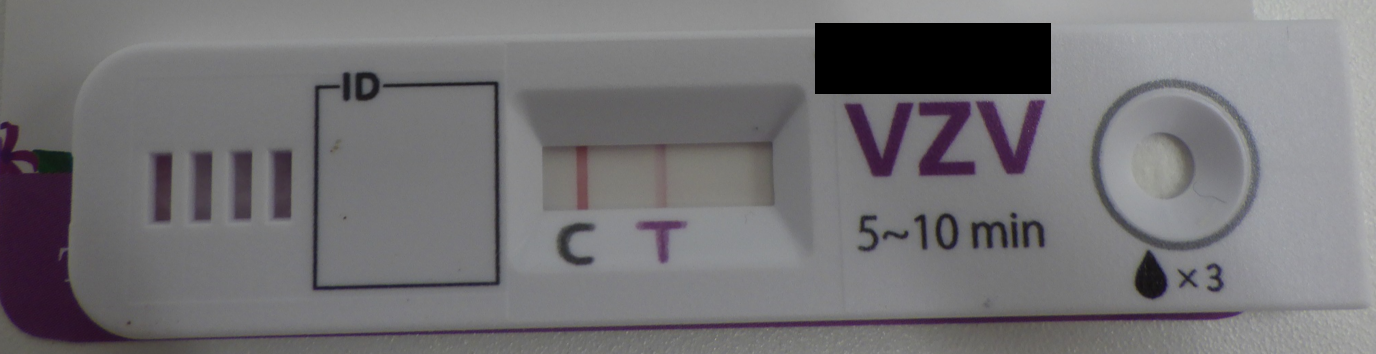
Image 1. This is a prompt diagnostic test kit for shingles, DermaQuick®. An extremely small tissue sample (1 to 2 mm) is taken from the vesicles of a patient and a purple line on the T line (test line) within ten minutes it can usually indicate a positive result. A purple line on the C line (control line) indicates that the test was done appropriately.
The risk of developing shingles and post-herpetic neuralgia
Chickenpox infection can lead to shingles development later in life. There is a study that explored numerous reports on incidents of shingles from around the world1). Part of the countries involved in this study includes the United States, Canada, the United Kingdom, Germany, Japan, the Netherland, Spain, Taiwan and many more countries (the order of the countries listed follows the number of investigated reports).
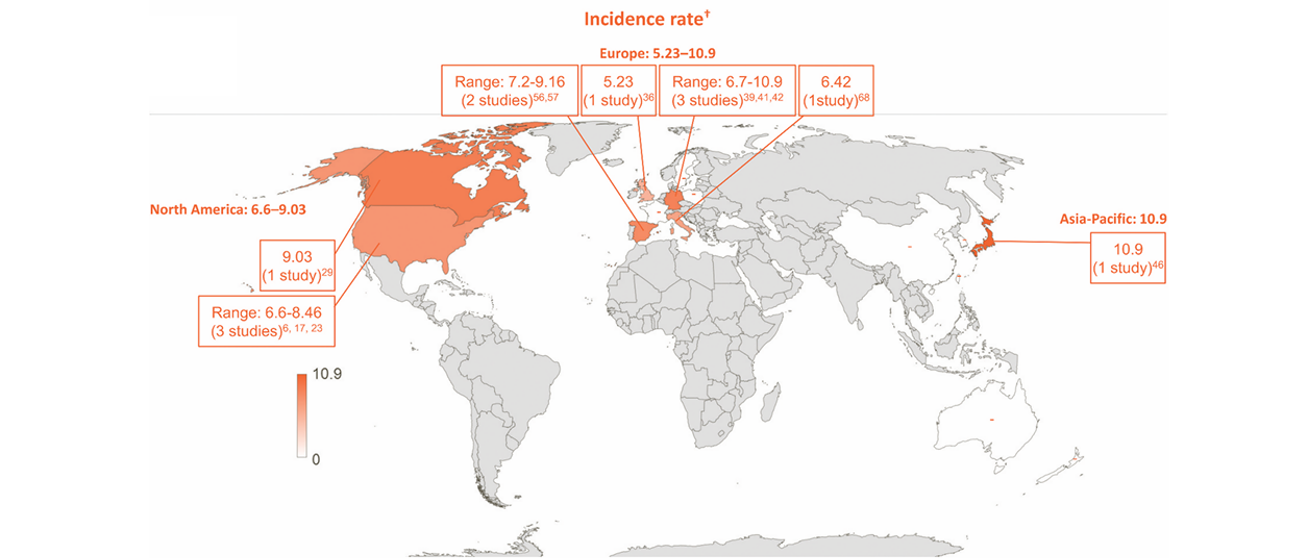
Figure 3 shows the incidence rate of patients who develop shingles within a year among 1,000 individuals above 50 years of age. 5 to 10 patients out of 1,000 develop shingles within a year worldwide.
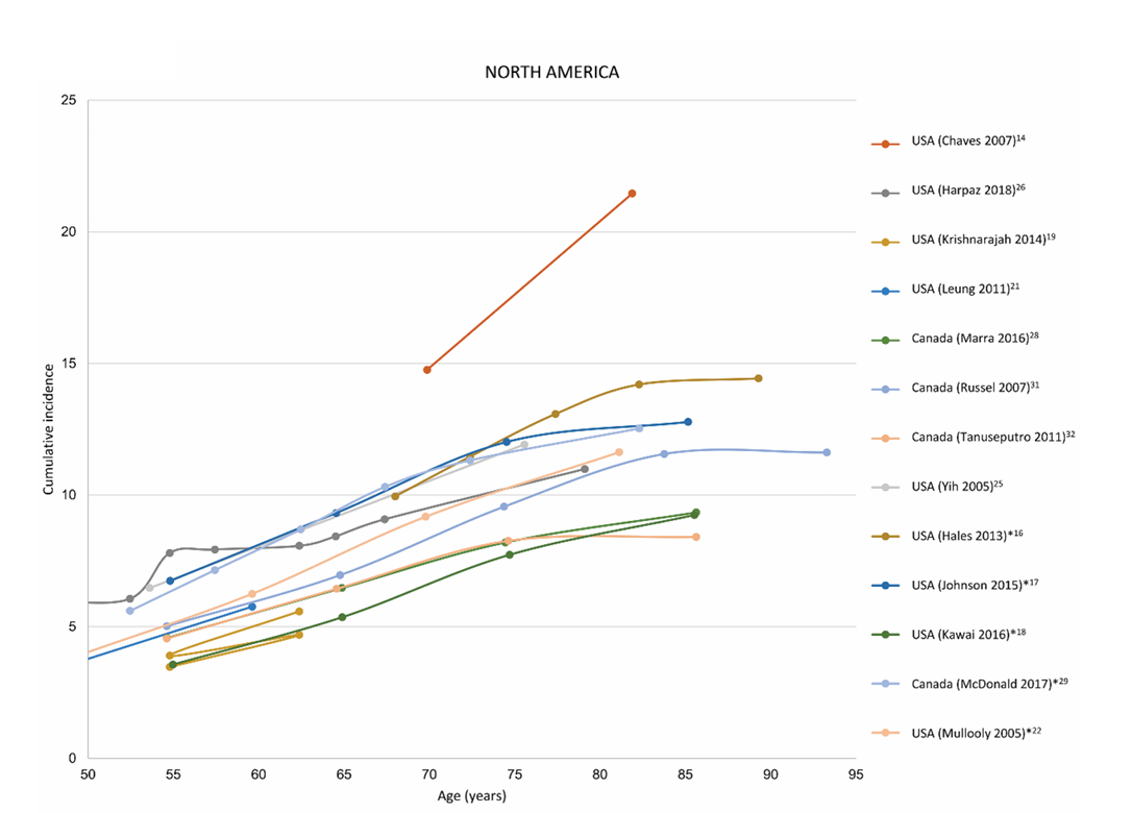
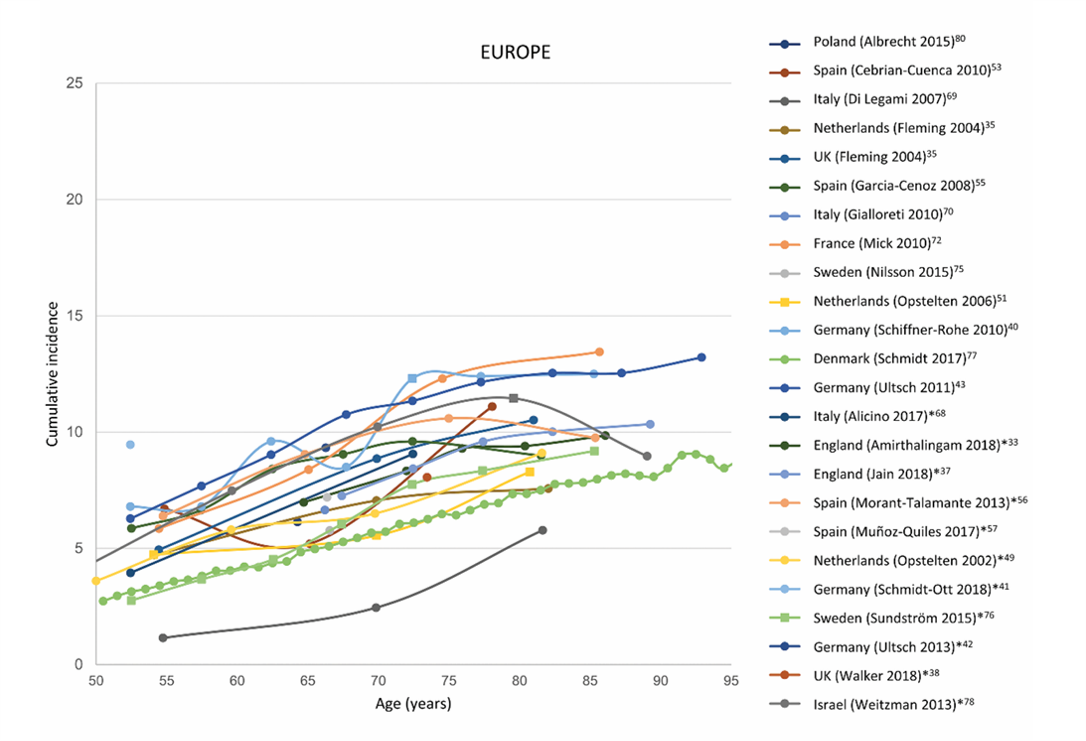
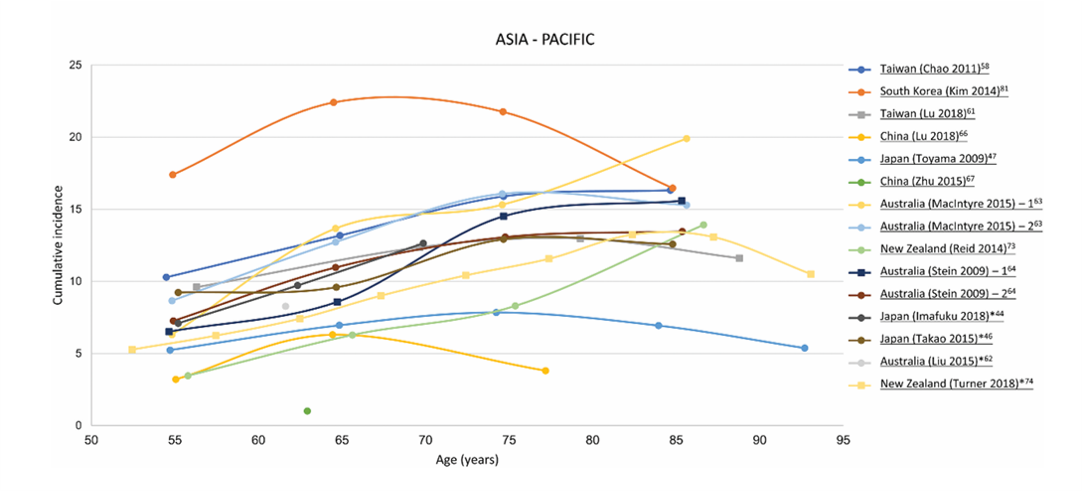
Figure 4 to 6 shows incidence of shingles by per country, (North America, Europe, and Asia-Pacific area). The authors assessed that there was a general tendency that the incidence rate increases as age increases, although some countries showed that the incidence declined in elderly groups.
As for the risk of developing post-herpetic neuralgia, increased age, severe acute pain during shingles, rash severity, and ocular involvement are listed in meta-analysis 2.
1)Hum Vaccin Immunother. 2021;17:1714-1732
2)Pain. 2016;157:30-54
Figure 3 shows the incidence rate of patients who develop shingles within a year among 1,000 individuals above 50 years of age. 5 to 10 patients out of 1,000 develop shingles within a year worldwide.
Figure 4 to 6 shows incidence of shingles by per country, (North America, Europe, and Asia-Pacific area). The authors assessed that there was a general tendency that the incidence rate increases as age increases, although some countries showed that the incidence declined in elderly groups.
As for the risk of developing post-herpetic neuralgia, increased age, severe acute pain during shingles, rash severity, and ocular involvement are listed in meta-analysis 2.
1)Hum Vaccin Immunother. 2021;17:1714-1732
2)Pain. 2016;157:30-54
Shingles vaccines
As a prophylaxis (prevention) against shingles, if you are 50 years of age and above, you are eligible for vaccines listed below, in Japan.
We only deal with SHINGRIX® at our clinic.
(1) A live attenuated (weakened) vaccine, BIKEN®, is a vaccine using weakened varicella-zoster virus itself
(2) An inactive vaccine, SHINGRIX®, is a vaccine that contains a surface protein particle of varicella-zoster virus.
As of 2023, SHINGRIX® was additionally approved for those 18 yeas of age and above who have higher risk of developing shingles
The characteristics of BIKEN® and SHINGRIX® are shown in the table 1. The data of the preventive effect of BIKEN® is based on the result of ZOSTAVAX® which is regarded to have the same efficacy as BIKEN®.
We only deal with SHINGRIX® at our clinic.
(1) A live attenuated (weakened) vaccine, BIKEN®, is a vaccine using weakened varicella-zoster virus itself
(2) An inactive vaccine, SHINGRIX®, is a vaccine that contains a surface protein particle of varicella-zoster virus.
As of 2023, SHINGRIX® was additionally approved for those 18 yeas of age and above who have higher risk of developing shingles
The characteristics of BIKEN® and SHINGRIX® are shown in the table 1. The data of the preventive effect of BIKEN® is based on the result of ZOSTAVAX® which is regarded to have the same efficacy as BIKEN®.
|
SHINGRIX®
|
BIKEN®
|
|
|
Type of vaccine
|
Inactive vaccine
(Virus protein particle) |
Attenuated live vaccine
|
|
Preventive effect against shingles
|
90 % prevention rate 4 years after inoculation 1)
73 %, 10 yeas after inoculation 1) |
51 % prevention rate 3 years after inoculation 2)
37 % 7 to 11 years after inoculation 3) (Data is based on the preventive effect of ZOSTAVAX®) |
|
Vaccination candidates
|
50 years of age and above
18 years of age and above with high risk of developing shingles |
Only 50 years of age and above
|
|
Exemptions
|
Fever above 37.5 ℃ at the time of inoculation
With any acute severe illness History of severe allergic reaction to any component of the vaccine Anyone who is judged as inappropriate to be vaccinated by medical professionals |
Fever above 37.5 ℃ at the time of inoculation
With any acute severe illness History of severe allergic reaction to any component of the vaccine Anyone who is judged as inappropriate to be vaccinated by medical professionals Immunocompromised patients (anyone who is on steroids or other immunosuppressants cannot get vaccinated) |
|
Major side effects
|
Pain in injection site (78%)
Muscular pain (40%), Weakness (39%), Headache (33%) |
Injection site reaction (50.6%)
Muscular pain, joint pain (below 1%), Weakness (below 1-5%) |
|
Inoculation method
|
Intramuscular injection
|
Subcutaneous injecgtion
|
|
Necessary number of injections
|
Two (The second injection in 2 to 6 months after first shot)
|
One
|
|
Medical cost at our clinic
|
22,000 yen for one injection: 44,000 yen in total (two serial injections necessary)
As of 2023, 10,000 yen of subsidy is offered for each injection if you are a resident of Kodaira city |
BIKEN® is not provided at our clinic.
|
1) Strezova A. et al.: Open Forum Infect Dis. 9, 2022
2)Oxmen MN. et al: N Engl J Med: 352: 2271-84, 2005
3) Morrison VA. et al: Clin Infect Dis: 60: 900-9, 2015
2)Oxmen MN. et al: N Engl J Med: 352: 2271-84, 2005
3) Morrison VA. et al: Clin Infect Dis: 60: 900-9, 2015